Wind & weather
Will a motorized patio screen hold up in Arkansas wind?
Motorized patio screens are rated to 115 mph. That number comes from a test on a single unit under controlled conditions. It is not a promise that every size in every install will perform the same way.
Here is what we actually know from the field.
What the rating means and what it does not
A wind rating is a pass or fail result from one test. The screen either held or it did not. That tells you something real, but it is not the whole story. A 10x10 opening loads very differently than a 30-foot opening does. More surface area means more force on the mount, the hem bar, and the fabric. Nobody can tell you a 30-foot screen will perform like a 12x12 in the same storm. Anyone who says otherwise is guessing.
The mesh also matters. Screen fabric passes air. It does not stop air. That is actually a good thing in wind because the load on the frame is lower than it would be with a solid panel. But it does not stop debris. A branch, a piece of fence, hail, anything airborne can punch through or snap a guide rail. Flying debris is usually what does the damage, not the wind reading on the weather app.
What happened in Little Flock
An EF2 tornado came through Little Flock and took the roof off a house. The motorized screens on that home survived. No blowouts. Those screens were about 13 feet tall and 12 feet wide.
There is one detail worth knowing. The owner had left the screens down about a foot at the bottom. That gap let wind pass underneath instead of loading the full panel. Whether that was intentional or not, it reduced the pressure on the fabric and the mount. The manufacturer, SunPro, uses that footage when they train dealers. We have seen it. It is real.
That story is useful but keep it in context. That was one structure, two screens, one event. It is not a guarantee. An EF2 is also a very wide range. What it hit and at what intensity at that exact house is not something we know down to the number.
What we tell customers about severe weather
Roll the screen up if a serious storm is coming. That is the honest answer. Arkansas gets high straight-line wind, embedded tornadoes in squall lines, and hail. If your screen is down and a walnut comes off a tree at 60 mph, the walnut wins.
Rolling up takes about 30 seconds. Full travel from down to up is roughly that. If you have a motorized screen and you are watching a storm cell on radar, you have time. Use it. Do not gamble with it because you read that a screen survived a tornado one time.
How the mount handles the load
The part that actually carries the stress is the housing and how it connects to your structure. We mount at the header, not under it. The housing sits above the header and tucks out of sight. The screen drops from above. Most competitors mount the housing below the header where you can see it and it is not in the strongest position.
Our housing attaches in six locations. That is not a marketing phrase. Six points is what carries the roll and the fabric when the wind loads. We use a chemical bond and a mechanical bond on every job. Glued and fastened. Both.
When there is siding on the structure, we use standoff brackets. The fasteners go through the siding and hit solid framing. The siding carries no load. That matters because siding is not structural. If you are just screwing into siding, you are asking siding to hold the screen in a storm. We do not do that.
The size question
Our screens fit openings up to 30 feet wide and 18 feet tall. The bigger the opening, the more honest the conversation needs to be about what you are asking the screen to do. A 12x12 in an 80 mph wind with no blowouts is a real data point. A 30-foot screen in a similar storm is a different situation. We have installed a custom 16x20 shade unit at a hunting lodge in Tilly along with 18 other screens on that same property. Large installs are not new to us. But we are going to give you a straight answer about what is reasonable to expect, not just tell you what you want to hear.
We measure in straight inches, not feet and inches. That matters when you are fitting a screen to an exact opening and the framing is not perfectly square.
The short version
- Rated to 115 mph. A 12x12 has held at 80 mph in the field.
- A bigger opening loads harder. The rating on a small screen does not transfer automatically.
- Mesh passes air. It does not stop debris. Debris is usually what causes damage.
- The Little Flock EF2 story is real. One event, one structure. Not a blanket promise.
- Roll it up in severe weather. Thirty seconds. Do not leave it down and hope.
- Header mount, six attachment points, chemical and mechanical bond on every job.
- Standoff brackets on siding so fasteners hit framing.
- We come out in person before any numbers are discussed.
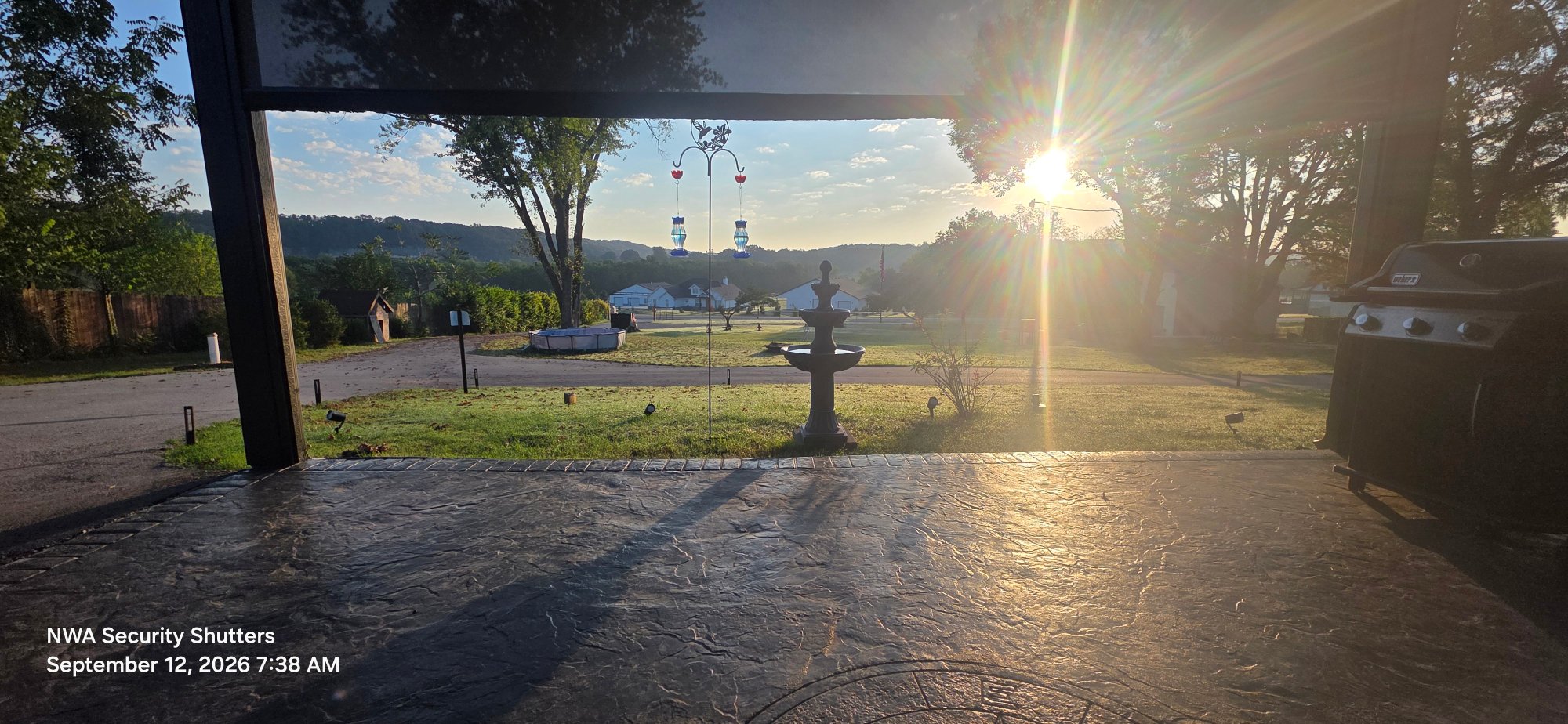
Come look at your opening with us
The site visit takes about twenty minutes and there is no charge. We measure the opening, check what the mounting is going into, and tell you what will work. Housing colors and fabrics have to be seen in person anyway.
Book a free site visit